
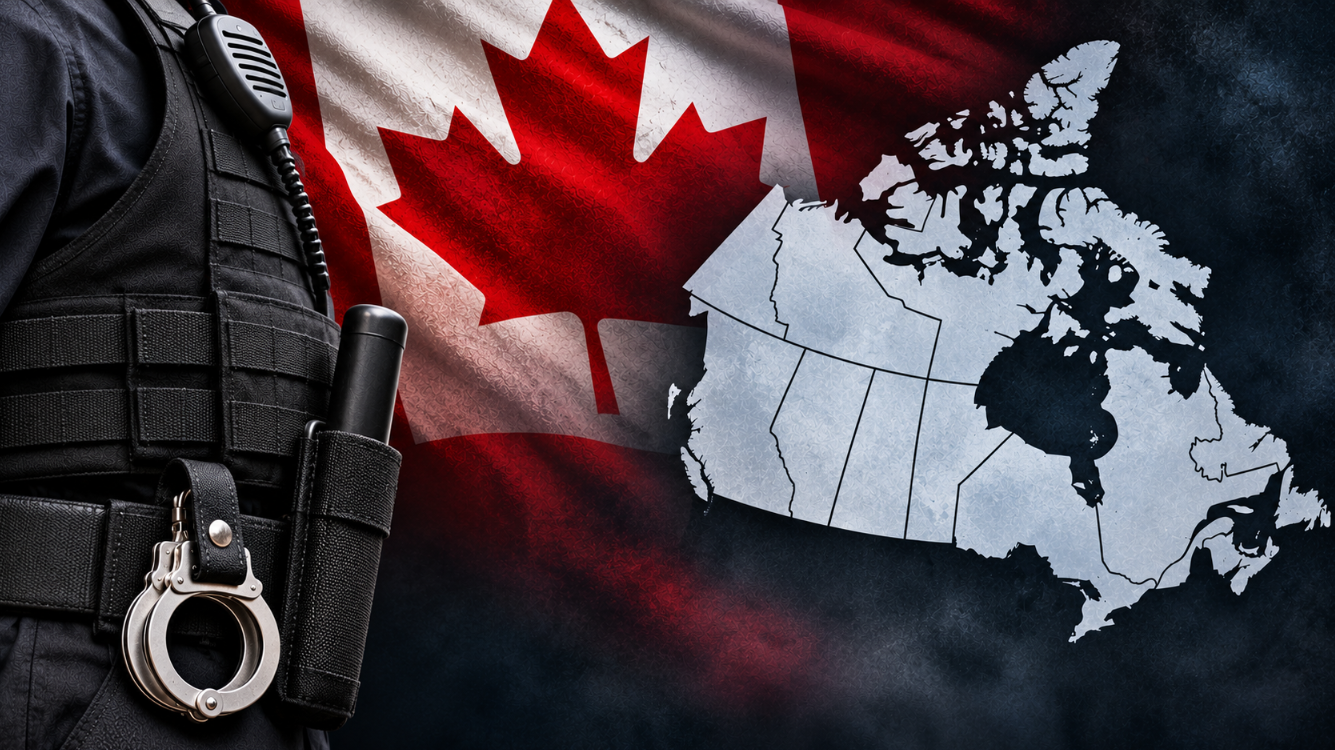
A security guard in Vancouver is prohibited from carrying a baton. A guard in Toronto can be issued one by their employer. A baton that requires a 40-hour course in Alberta follows a different approval process in New Brunswick. And a guard who moves between provinces may find that previous training does not satisfy local requirements.
The Criminal Code applies nationally, but provinces regulate the security industry through their own legislation, licensing systems and equipment rules. Understanding those differences matters for individual security professionals and for employers operating across provincial boundaries.
The Federal Foundation: What the Criminal Code Says
Before looking at provincial differences, it helps to understand what stays constant across Canada.
Section 34 sets out the framework for defence of oneself or another person. It asks whether the person reasonably believed that force or a threat of force was being used, whether they acted to protect themselves or someone else, and whether their actions were reasonable in the circumstances. Section 35 applies similar reasoning to the defence of property, which is often the context in which guards find themselves.
Section 25 protects people who use force while required or authorized by law to administer or enforce the law, including private persons in appropriate circumstances. It is not a general authorization for guards to use force on the job. Section 26 establishes criminal responsibility for excessive force, and Section 494 outlines the limited circumstances in which private citizens, including security guards, may arrest without a warrant.
None of this gives a guard the authority of a police officer. A security licence, uniform or training certificate does not create an independent right to use force. Every physical intervention needs a lawful basis, and the force used must be justified by the circumstances.
British Columbia: Strict Equipment Restrictions
British Columbia is the clearest example of a restrictive approach. The province prohibits licensed security workers from carrying or using items designed to injure or control people, including batons, Tasers and pepper spray, while performing security work.
Handcuffs are treated differently. Workers may apply for a restraint authorization, which is tied to Advanced Security Training. Workers who use force must also complete a Use of Force Incident Report or an equivalent record and give it to their manager.
For frontline guards, the distinction matters: completing defensive tactics training does not authorize carrying defensive equipment. Provincial licence conditions decide what may be carried on duty.
Alberta: Specific Baton Training Requirements
Alberta takes a different approach. A guard may carry a baton only with employer approval and after completing an approved 40-hour baton use-of-force course. The training certificate must accompany the licence application, and baton training must be recertified every 36 months.
Alberta shows the gap between general security licensing and authorization for specialized equipment. A guard can be fully qualified for ordinary duties without meeting the additional requirements to carry a baton.
Manitoba: A Cautious Approach to Batons
Manitoba's published guidance advises security guards and private investigators not to carry or use batons, truncheons, nightsticks or similar items as weapons. Batons are not prohibited weapons under federal law, but the province warns that possessing or using them could put an individual in violation of the Criminal Code.
Handcuffs are not specifically prohibited, but Manitoba says their use should be closely monitored by the employer and limited to the narrow circumstances in which force to restrain someone is lawful.
The lesson is that equipment does not need to be expressly prohibited by federal law to raise provincial regulatory or legal concerns.
Ontario: Employer-Issued Equipment and Accountability
Ontario permits licensed guards to use employer-issued batons for defensive purposes only, and to use employer-issued handcuffs, subject to regulatory conditions. Much of the responsibility falls on the employing agency.
Under O. Reg. 366/07, the employer must carry insurance covering the risks of employees carrying batons. Under O. Reg. 434/07, it must keep records of the guards authorized to carry defensive equipment, their training, the credentials of their instructors, and its insurance coverage. An equipment log must document each issuance. For every baton issued, the employer must hold a documented threat assessment setting out why the guard needs to carry it. Employers must also keep Use of Force reports when guards use handcuffs, batons or other force.
Issuing defensive equipment in Ontario is not simply handing a guard a baton. It creates continuing obligations for training, documentation, risk assessment and accountability.
Quebec: A Distinct Licensing Framework
Quebec regulates private security through its own framework, administered by the Bureau de la sécurité privée. Guarding requires at least 70 hours of recognized training.
Basic training and authorization to carry defensive equipment are separate matters, however. Employers in Quebec must verify the specific requirements for each assignment, including any restrictions on batons or other defensive tools. Companies operating across provincial lines should not assume that practices accepted elsewhere will be accepted in Quebec.
New Brunswick: Formal Authorization
New Brunswick has a structured process for guards and agencies that want to supply or carry batons and handcuffs. Since 2024, a guard may not carry either unless their licence bears an authorization, and applicants must provide a certificate of completion of a training program approved by the Minister. Agencies that supply the equipment must keep detailed records, including a threat assessment for each baton supplied and a record of every use of a baton or handcuffs.
The regulation also sets equipment specifications. Batons may not exceed 66 centimetres or be spring-loaded, and handcuffs must be made of metal. Recertification requirements are set out in the department's security services training policy, which agencies and guards should consult directly.
Authorization involves far more than completing a course. Licensing, employer procedures, training records and equipment specifications all matter.
Nova Scotia: Licence Endorsements Matter
Nova Scotia's Private Investigators and Private Guards Regulations require an appropriately endorsed individual licence to carry a baton or a restraining device, and carrying either without the endorsement is an offence. A newer Security and Investigative Services Act passed in 2010 but has never been proclaimed, so the older regime still governs.
Guards and employers should confirm that the endorsement has actually been issued before any equipment is carried. General licensing and employer approval are not a substitute.
Saskatchewan, Prince Edward Island, and Newfoundland and Labrador
Each of these provinces regulates private security through its own legislation and licensing authority. Requirements for batons, restraints and related training differ from the provinces above, and they must be confirmed with the relevant regulator before equipment is issued.
Recognition of a licence or training certificate from another province, where it exists, applies to licensing. It should not be confused with permission to carry a particular piece of defensive equipment. Employer authorization alone is never sufficient.
The Territories
The territories are not uniform. Yukon licenses security guards and agencies under its Private Investigators and Security Guards Act. The Northwest Territories, by contrast, had no territorial licensing framework for security guards as of early 2026, and territorial legislators were publicly calling for one. Nunavut has also historically lacked an equivalent system, though its current status should be confirmed with the territorial government.
The federal Criminal Code applies everywhere, and the absence of a licensing regime does not expand a guard's legal authority to use force. Companies deploying across the North should verify the position in each territory, and should set their own internal standards where the territory sets none.
The broader point holds across the country: a security professional's credentials and equipment authorizations should never be assumed to transfer between jurisdictions.
Where Can Security Guards Carry a Baton?
Baton rules show the differences most clearly. In some jurisdictions batons are prohibited for ordinary security work. In others they are permitted only after specific training, employer approval or a licence endorsement. The chart and table below summarize the provinces where requirements are most clearly defined.
Requirements for Saskatchewan, Quebec, Prince Edward Island, Newfoundland and Labrador and the territories should be verified directly with their regulators.
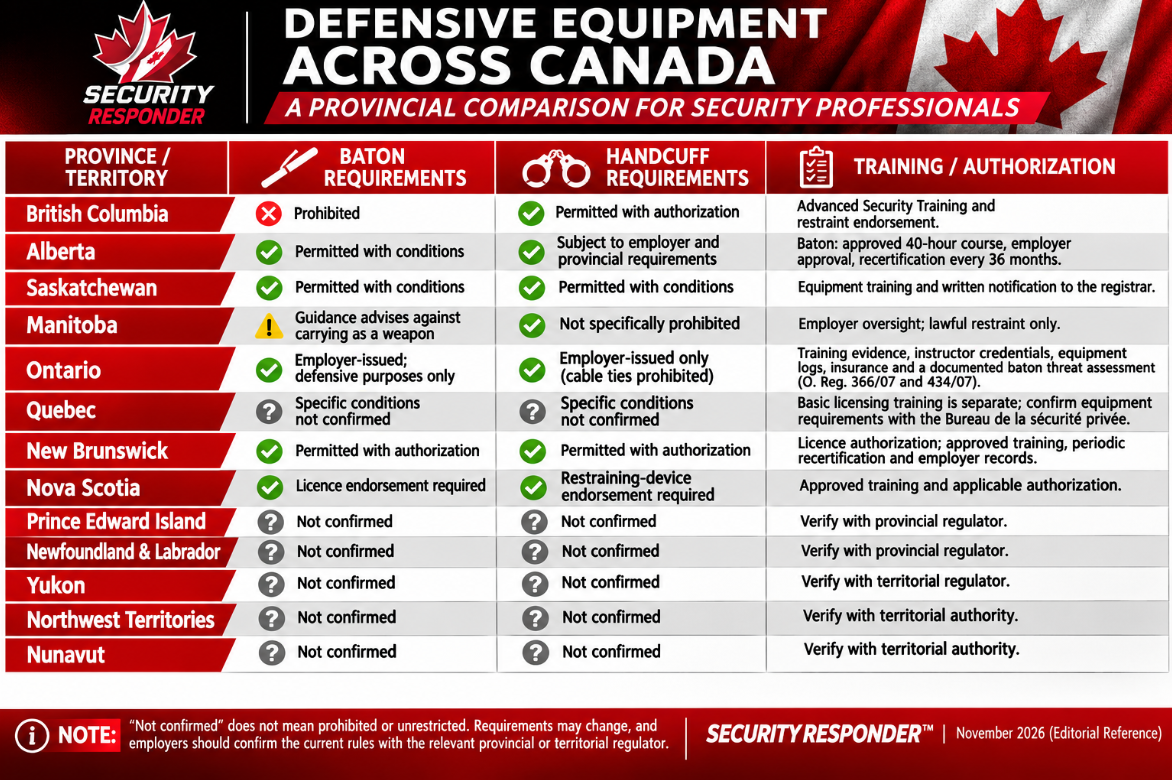
| Province | Baton requirements |
|---|---|
| British Columbia | Prohibited while performing licensed security work. |
| Alberta | Employer approval, an approved 40-hour baton course, and recertification every 36 months. |
| Manitoba | Provincial guidance advises against carrying or using batons as weapons. |
| Ontario | Employer-issued and for defensive use only, with insurance, recordkeeping and a documented threat assessment for each baton issued. |
| New Brunswick | Authorization noted on the guard's licence, Minister-approved training, and agency records including a threat assessment for each baton. Baton length is capped at 66 cm and spring-loaded batons are not permitted. |
| Nova Scotia | Individual licence endorsement required. |
Issued a Tool. But Trained to Use It?
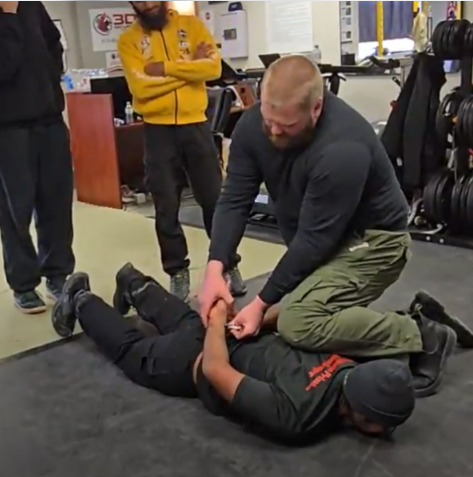
I have taught Kali, a Filipino martial art emphasizing edged and impact tools, for many years. One aspect of how the security industry approaches defensive equipment concerns me.
We sometimes seem to believe that issuing a baton and providing a short course is enough preparation for a violent confrontation. I would challenge that. A baton is a defensive tool, but it is also an impact instrument capable of causing serious injury. Carrying one brings responsibilities that go well beyond knowing how to hold it or demonstrating a few techniques in a controlled setting.
In my experience, competence with an impact tool requires repetition, judgment, physical coordination and the ability to decide under pressure. Those skills do not become permanent because someone passed a course.
If a baton is the primary defensive tool we give a guard, how much training should that person receive before being expected to rely on it?
Alberta requires an approved 40-hour baton course and recertification every 36 months. New Brunswick requires Minister-approved training before a baton can be carried. These are meaningful expectations. But the broader question remains whether periodic recertification alone is enough to maintain practical competence.
Consider what we expect of a frontline guard. They must recognize developing threats, attempt de-escalation, understand their legal authorities, decide under stress and, when justified, use only the force reasonably necessary. That is a great deal to ask of someone who may rarely practise the physical skills they were taught.
“A baton should never be issued to make a guard look more authoritative, and it should never substitute for communication skills, situational awareness, teamwork or sound judgment.”
Training Should Not End With Certification
Initial certification should be the beginning of a guard's defensive tactics development, not the end. An effective program establishes competence before a baton is issued, then reinforces it through regular practice, practical assessments and realistic decision-making scenarios.
This does not mean every guard must become a martial artist. It does mean anyone expected to carry a defensive tool should be able to demonstrate safe handling, sound judgment, awareness of legal limits, and the ability to disengage or seek help when appropriate.
Continuing education should go beyond rehearsing techniques. It should reinforce communication, threat recognition, proportionality, medical considerations, reporting, and the duty to stop using force once the justification ends.
A reasonable professional model could include supervised refresher training every quarter, annual practical competency assessments, and additional training whenever legislation, equipment or operational responsibilities change. These are proposed professional standards, not a claim that any province currently requires them.
The Responsibility of the Employer
There is also an uncomfortable question for security companies. If an employer decides an assignment is risky enough to justify issuing a baton, shouldn't that same assessment justify meaningful initial and continuing training? We cannot identify a need for defensive equipment while treating the training needed to use it competently as an unnecessary expense.
A baton should never be issued to make a guard look more authoritative, and it should never substitute for communication skills, situational awareness, teamwork or sound judgment. It is a tool for circumstances in which lawful defensive intervention may become necessary, and that responsibility deserves serious preparation.
The goal is not guards who are eager to use force. It is professionals who understand its consequences, recognize its limits, and have the competence to make sound decisions when circumstances demand them.
Toward a National Standard of Professionalism
The differences across Canada raise a fair question: should there be more consistent national expectations for defensive tactics and use-of-force training?
A national standard would not require identical equipment rules in every province. But common expectations for legal knowledge, de-escalation, defensive skills, practical assessment, recertification and documentation could improve professional consistency.
Until then, the responsibility rests with security professionals and employers to understand the rules where they work and keep training relevant to the risks they face. A guard's authority does not travel automatically with their uniform, certificate or equipment, and legal justification must always be assessed against the circumstances of the incident.
Knowing how to use force is only part of the equation. Equally important are knowing when you are legally permitted to use it, whether you are authorized to carry the equipment, and whether you have maintained the competence to use it responsibly.
If we believe a security guard needs a baton to perform their duties safely, we should also believe they deserve the training necessary to carry it responsibly.
Scott Hill is president of 3D Security & Emergency Response Services and editor of Security Responder Magazine.
Legal Disclaimer
This article is provided for general information and professional education only. It does not constitute legal advice. Laws, regulations, licensing requirements and authorizations concerning defensive equipment and use of force vary by jurisdiction and may change.
Security professionals and employers should verify current requirements directly with the appropriate provincial or territorial regulatory authority before carrying, issuing or using defensive equipment.